


Netflix Muse is not just another analytics dashboard story. Its real value is that it shows what happens when an internal data product grows from simple reporting into a business-facing decision system. Muse helps creative strategists and launch teams understand which artwork or video assets resonate with different audiences, while also detecting misleading or abnormal promotional media. The core problem was scale plus flexibility: users wanted richer filtering, grouping, audience-affinity analysis, outlier detection, and low-latency exploration on data that had grown to trillions of rows per year.
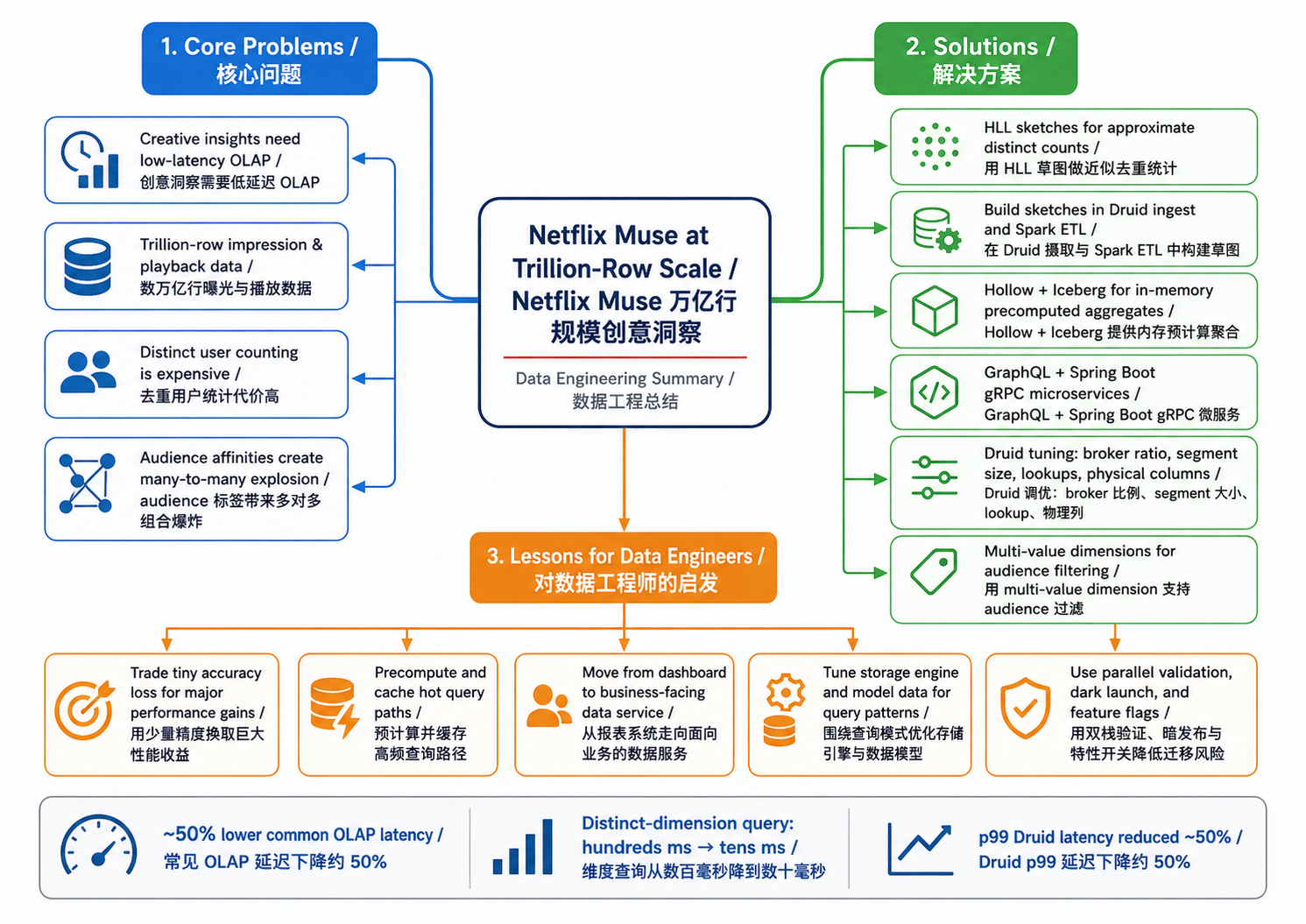
The original architecture, based on Spark pipelines and a modest Druid cluster, was no longer enough. The hardest pressure came from audience affinities. These labels are many-to-many relationships between viewers, tastes, titles, impressions, and playback behavior. Once Muse needed to ask questions such as whether a creative asset worked better for one audience group than another, the data model started to expand combinatorially. A physical-table-first design would keep adding columns, joins, and query paths until latency and correctness became hard to control.
Netflix solved this by evolving Muse into a more layered serving architecture: a React application queries a GraphQL layer backed by Spring Boot gRPC microservices, while the data layer combines Spark ETL, Apache Druid, Iceberg, HyperLogLog sketches, and Hollow. HLL sketches reduce the cost of distinct counting, especially for impression and audience metrics, and Netflix reported roughly 50% latency improvement across common OLAP query patterns. Hollow moves selected precomputed aggregates into highly compressed in-memory read-only key-value feeds, offloading Druid for access patterns with limited parameter combinations. Druid was still important, but it had to be tuned through ingestion filtering, predicate optimization, segment sizing, and cluster-level changes.
The most valuable lesson for data engineers is that scaling analytics is not only about choosing a faster database. Muse scaled because Netflix redesigned the data product around query intent, metric shape, and operational risk. They used parallel legacy/new metric stacks, offline validation in Jupyter, in-app comparison tooling, dark launches, and fine-grained feature flags. That is the industrial-grade part of the case study: performance optimization and trust-building were shipped together. For enterprise data platforms, Muse teaches that a mature serving layer should know which metrics need real-time OLAP, which can be approximated safely, which should be precomputed, and how to validate changes before business users see them.
Source: Netflix TechBlog