


Netflix UDA is valuable not because it introduces one more metadata system, but because it reframes the core abstraction of a data platform. In many traditional stacks, engineering starts from physical tables, storage engines, SQL jobs, and field-level pipelines. That approach works early on, but it becomes fragile at scale because the same business concept gets redefined across APIs, warehouses, files, and application code.
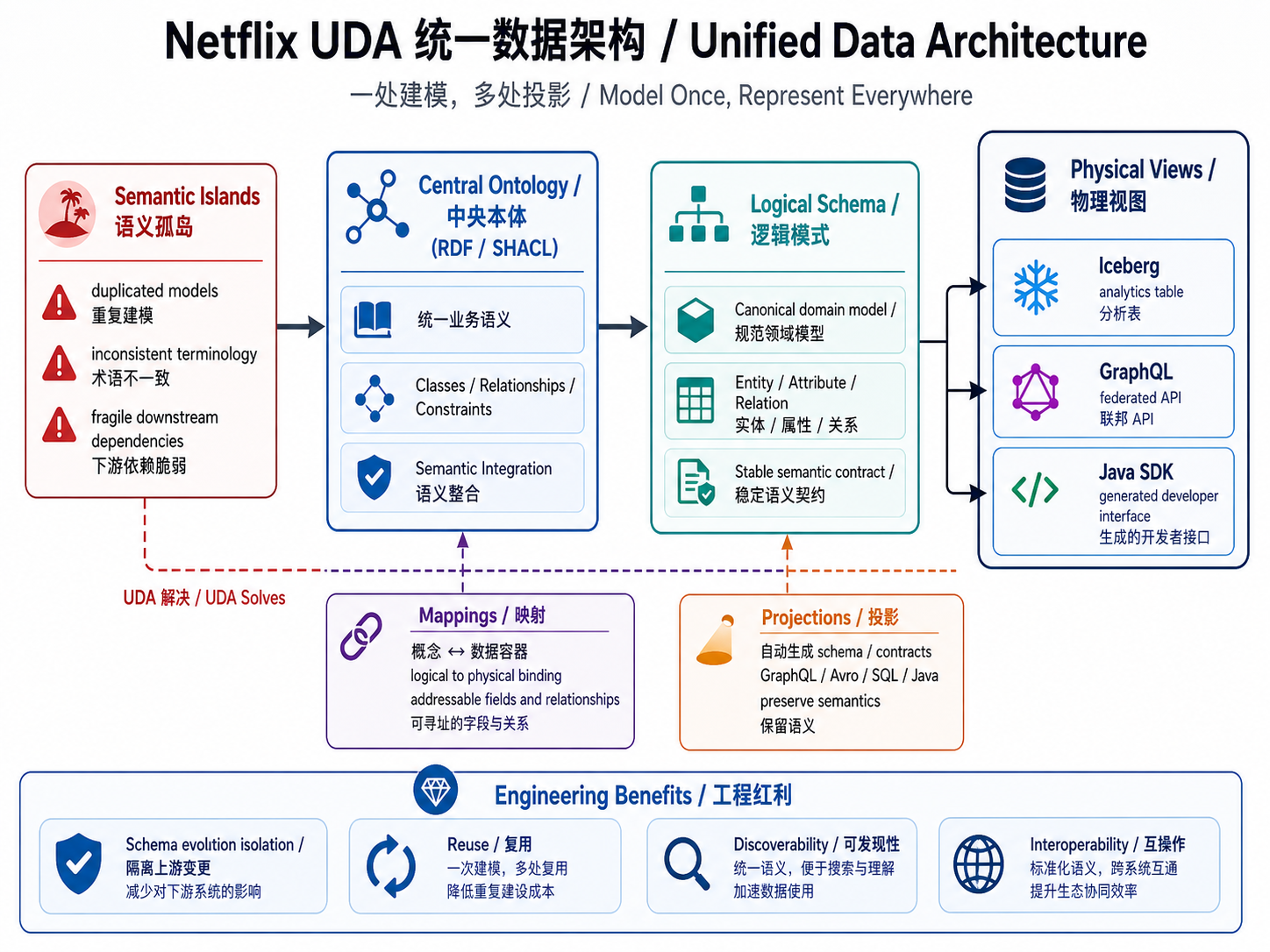
UDA shows a different direction: treat the logical semantic model as the control plane, and treat physical schemas as projections of that model. With a central ontology, logical schema, mappings, and projections, one business concept can be defined once and represented consistently in GraphQL, Iceberg, Java SDKs, and other technical forms.
From a data engineering point of view, four lessons stand out. First, model reuse reduces duplicated design work. Second, semantic contracts are more stable than table contracts, so downstream systems break less often. Third, discoverability improves because users search for concepts like actor or movie instead of decoding table names and join keys. Fourth, automation becomes realistic: once mappings and projections are explicit, platforms can generate schemas, contracts, and access paths with much less manual work.
The most important idea is not simply “reduce schema-change impact.” It is to isolate upstream change behind a semantic layer. If the business meaning stays the same, the platform should absorb physical change in mappings or regenerated projections instead of forcing every downstream report, API, and pipeline to repair itself. For enterprise data platforms, this is the real takeaway: the future control plane is built on unified semantics, contracts, discovery, and governance, not just unified storage and compute.